Using a Body Camera to Document Harassment and Neighbor Disputes
Put safety first and consider appropriate ways to document incidents without escalating a dispute.
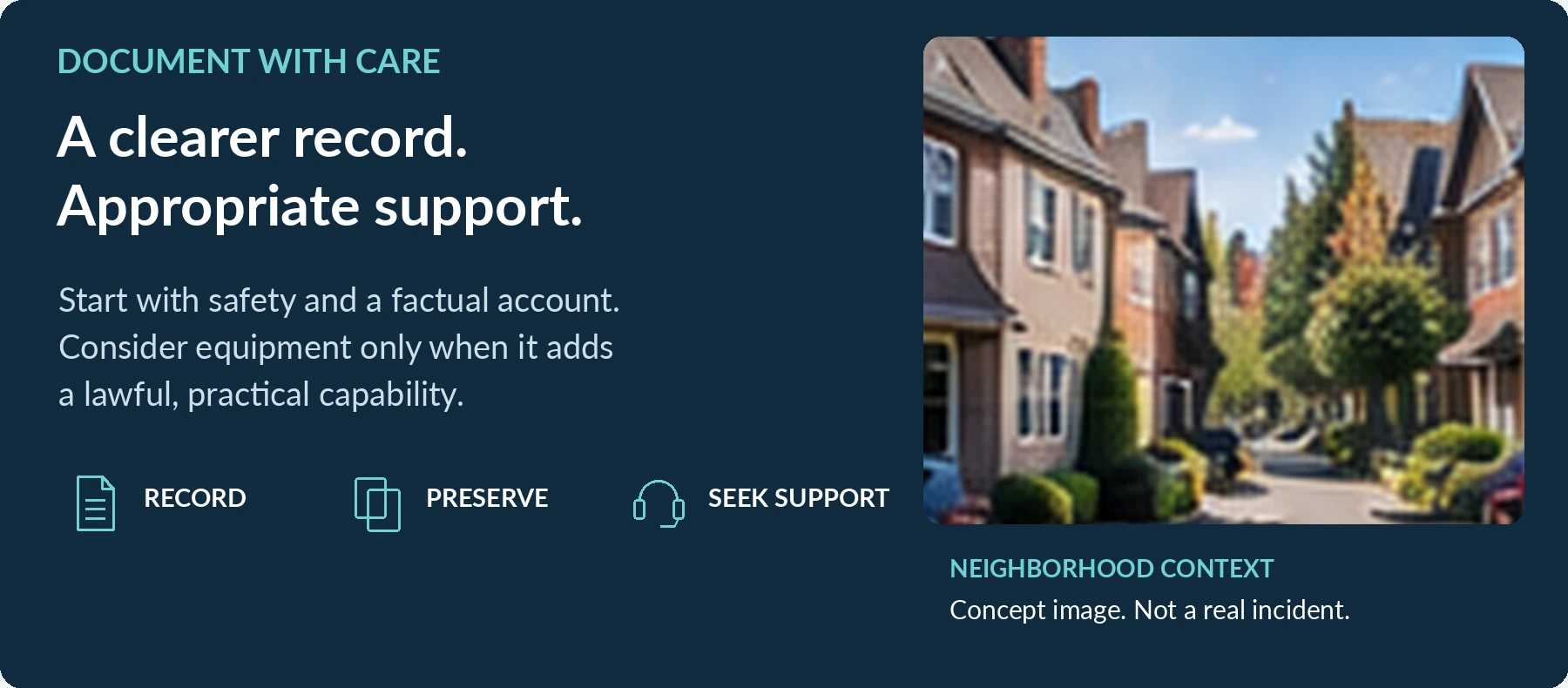
Editorial guidance, not legal advice or a model-specific performance promise. Check the rules and requirements that apply to your location and use.
You do not need a camera or a complete evidence folder before asking for help. In immediate danger, seek safety and contact local emergency services when you can. [1]
General editorial information. Not case-specific legal advice, a forensic certification, a safety guarantee, or an assessment of anyone’s conduct.
Editable tools: the incident log and submission record are optional planning aids, not official forms. Keep safe addresses, passwords, relocation plans, and unrelated private information out of general worksheets. [11]
All diagrams are conceptual. Fictional examples and test plans are not genuine incident evidence, product results, or promises of legal acceptance.
Begin with safety, not equipment
A body camera may help document a particular incident when recording is lawful and safe. It is not a prerequisite for asking for help, a reason to remain in a confrontation, or a guarantee that a complaint will succeed. Police.uk explicitly says that people do not need to gather photographs, videos, or messages before reporting stalking or harassment. [1]
The useful question is:
“Can I preserve an accurate account of what happened without increasing contact, exposing private information, or putting myself at greater risk?”
Start with safety, appropriate support, and a simple incident record. Then assess whether a camera adds anything necessary. Unlike our everyday walking and commuting guide, this article addresses situations in which someone already has a specific concern to document.
The examples and worksheets are fictional planning tools. They do not establish that a particular person has committed harassment, stalking, or another offense.
![Safety-first editorial summary. Ask for help without delaying to complete a recording or collect more material. [1–4]](https://spikecam.com/wp-content/uploads/spikecam-knowledge/b07/figure-02.webp)
Put Safety and Help Before Recording
In immediate danger, seek safety and contact local emergency services when you can. Do not delay assistance to activate a camera, finish a clip, or gather more material. Police.uk's reporting guidance directs people in immediate danger to emergency assistance rather than evidence collection. [1]
Do not approach someone to provoke a repeat of an earlier remark, follow them for identification footage, or return to an uncomfortable encounter to improve the camera angle. Police advice on stalking and harassment recommends minimizing contact and recording details afterward when possible. [2]
Do not assume that a visible camera will de-escalate an encounter. NNEDV's Safety Net Project warns that discovering documentation can lead an abusive person to escalate their behavior. Consider the particular circumstances with a specialist advocate rather than assuming that showing the device will make an encounter safer. [3]
There is also no obligation to create a perfect record. A late start, an obstructed lens, or having no camera does not make another person's conduct your fault.
When the concern involves a current or former partner, a family member, or someone with access to your home and accounts, seek specialist support. SPARC recommends connecting with a local victim-service provider for options and safety planning; its website provides information but does not itself offer direct victim services. [4]
02 / CHOOSE THE APPROPRIATE RESPONSE
Not Every Neighbor Disagreement Needs the Same Response
![Conceptual response routes, not a legal classification of any incident. Named public-resource examples retain their stated jurisdiction. [5–7]](https://spikecam.com/wp-content/uploads/spikecam-knowledge/b07/figure-03.webp)
A disagreement about maintenance, noise, or a shared space should not automatically become a campaign of personal surveillance. Equally, do not dismiss threats or repeated unwanted contact merely because the person lives nearby.
For ordinary disputes, GOV.UK describes options including a landlord, mediation, and a council complaint about statutory nuisance. It separately directs people to the police for violence or harassment. These are examples from that guidance, not a universal procedure for every country. [5]
Do not apply “go and talk it out” automatically where there is fear, intimidation, or suspected stalking. Police Scotland's stalking advice recommends avoiding engagement and refusing meetings with the person involved. Seek advice about a safe reporting route before arranging contact or mediation. [6]
For a noise concern, ask the relevant authority what diary, recording, or assessment it needs. For a property-condition dispute, assess whether dated photographs, repair records, or a written report answer the question. A wearable camera should address a defined gap, not replace those processes.
Describe what happened without needing to select the correct legal label yourself. The Metropolitan Police says to report even when you are unsure whether conduct is stalking or harassment; a single unwanted incident may also constitute a different offense. Do not wait for another incident solely to reach an assumed numerical threshold. [7]
Keep the question specific: ask what diary, report, photograph, or other record the appropriate recipient needs. A body camera is not the default answer to every disagreement.
03 / RECORDING BOUNDARIES
Check Where and How You May Record
![Four distinct checks: place, video, audio, and disclosure. This is a scope reminder, not recording permission. [8–10]](https://spikecam.com/wp-content/uploads/spikecam-knowledge/b07/figure-04.webp)
Being involved in a dispute does not create a general permission to record anywhere, collect every conversation, or publish the result. Check video, sound, location, and intended disclosure separately.
United States: examine the applicable state and circumstances. California Penal Code section 632, for example, addresses recording confidential communications without all-party consent and qualifies what counts as confidential. It does not establish that every US interaction follows the same rule, or that standing outdoors settles the question. [8]
United Kingdom: distinguish personal use from an organizational surveillance scheme. The ICO says its organizational guidance does not apply to purely personal or household recording. That scope distinction does not decide whether your particular recording pattern qualifies, and the guidance is marked as under review. [9]
European Union: the EDPB interprets the household exemption narrowly and distinguishes private activities from making identifiable recordings available to an indefinite online audience. Assess the purpose and scale of recording alongside national requirements; calling a device a “personal safety camera” is not the assessment. [10]
Keep the proposed capture limited to the relevant, permitted activity. Do not point into neighboring private interiors, hide equipment in someone else's space, or monitor unrelated residents' movements to search for something incriminating. Do not trespass or interfere with another person's belongings.
Ask a qualified local adviser about required information or consent, private and shared areas, and any court order or property restriction affecting the situation. When lawful recording would require a step you cannot take safely, prioritize leaving and reporting over obtaining footage. This guide is not case-specific legal advice.
04 / AN ACCURATE INCIDENT LOG
Build an Incident Record, Not Just a Video Collection

Start with a brief written account when it is safe. A camera file is one possible attachment, not the entire record. Police.uk recommends noting dates, times, witnesses, and relevant details promptly. SPARC provides a documentation log for organizing incidents and associated material. [2] [11]
Use the following worksheet as a suggested structure, not a required police form:
| Field | What to record |
|---|---|
| Incident reference | A simple identifier, such as DEMO-INC-007 for a practice entry. |
| Event time and entry time | When it happened, including the time zone where useful, and when you wrote the note. Mark estimates as approximate. |
| Location and observation | What you directly saw or heard, at the relevant location. Avoid assumptions about motive. |
| Words and identification | Exact words only when accurately remembered; otherwise label a paraphrase. Explain any uncertainty about who was involved. |
| Impact and response | How the event affected you and what you did, without guessing the other person's mental state. |
| Supporting material and limits | Original file references, relevant messages, potential witnesses, and missing sound or obstructed views. |
| Report and follow-up | Agency or recipient, date, reference number, material submitted, and agreed next steps. |
Separate three things in your writing: your observation, what someone else told you, and what you infer. For example, “I found a scratch on the door at 08:10; I did not see it being made” describes an observation without assigning responsibility.
Describe the impact in your own words. “I felt frightened and called a friend” is different from speculating that another person “wanted to control me.” Neither a factual account nor a record of feelings needs dramatic language to deserve attention.
When adding a detail later, date the addition rather than presenting it as part of an earlier note. Invite a witness to give their own account to the appropriate recipient; do not coach them into matching yours.
Preserve relevant messages and other material already available to you through lawful access. Safety Net notes that some apps notify the other person about screenshots or screen recordings. Check the actual app and seek a safer documentation method when necessary; do not treat every capture method as invisible. [3]
05 / A TIMELINE WITH VISIBLE LIMITS
A Fictional Timeline: Connect the Material Without Filling the Gaps

The following is a training example, not a real dispute, a finding of harassment, or a model of a legally sufficient case. All dates are in 2026; the dates and times are invented and use UTC−07:00.
| Entry | What is recorded in the note | Available material and limitation |
|---|---|---|
| DEMO-01 — Sept. 20, about 18:10 | The writer reports hearing a shouted remark near a shared entrance. The note was written at 18:25. | No video exists. The note distinguishes remembered wording from uncertainty. |
| DEMO-02 — Sept. 22, 07:40 | The writer reports receiving a message and records the displayed sender information. | The original message is retained through lawful access. A display name alone is not treated as proof of authorship. |
| DEMO-03 — Sept. 24, about 17:55 | The writer describes an interaction encountered during an ordinary trip through the entrance. | A camera clip starts after the exchange began. Part of the view is blocked; the note acknowledges both limits. |
This arrangement helps a reviewer locate each item and understand what it does and does not contain. It does not prove that the entries share a cause or satisfy a legal definition.
Do not recreate the first incident to supply missing footage. Keep the original account and explain the absence. A gap in a recording should remain a gap, not be filled with a reenactment presented as the event.
What Can a Body Camera Actually Establish?
Review the particular file before describing it as proof. Does it show the action, or only what happened afterward? Are the words audible? Was the person visible, or are you identifying a voice from memory?
A clip beginning with your response does not show everything said before activation. A view of damage does not automatically identify its cause. A person being present nearby does not, by itself, establish their intention.
Preserve relevant context even when it complicates your initial account. Do not remove your own speech, earlier exchanges, or nearby activity simply because a shorter clip is more persuasive.
Keep technical preservation separate from legal acceptance. Ask the intended recipient what it needs to assess the source, continuity, relevance, and lawful collection of the material. Do not assume a date stamp, protected-file setting, or “police-grade” label guarantees acceptance in a complaint or court proceeding.
This guide offers a documentation method, not a prediction about a legal outcome.
06 / PRESERVE THE SOURCE
Preserve the Original, a Backup, and a Separate Sharing Copy
![A source, an independent backup, and a separate working copy have different roles. Conceptual editorial workflow, not forensic certification. [12–13]](https://spikecam.com/wp-content/uploads/spikecam-knowledge/b07/figure-07.webp)
Once safe, use the manufacturer's supported process to locate and preserve relevant files. Check adjoining clips when they contain the beginning or end of the event. Do not immediately format the storage, reset the camera, or clear it to prepare for another outing.
NIST's Digital Evidence Preservation guidance addresses documented sources, integrity, and copies for professional evidence handlers. The arrangement below is an editorial adaptation, not a certified forensic procedure. [12]
| Copy | Its purpose |
|---|---|
| Preserved source recording | Retain the original recorded file or documented native export, together with necessary accompanying information. Do not edit it. |
| Independent backup | Keep a verified copy in another protected location appropriate to your safety situation. Confirm it opens. |
| Working or sharing copy | Use a separate, clearly labeled copy for an authorized excerpt, annotation, or redaction. Keep a note of what changed. |
Use direct file transfer or the supported export method where available. An edited compilation should not replace the source. SWGDE's Video and Audio Redaction Guidelines (version 2.3) recommends working from a copy, documenting alterations, clearly identifying redacted output, and checking playback. [13]
Our suggested handover note records the source, original filename, export date and method, recipient, and any conversion. Keep sensitive names and addresses out of ordinary filenames.
A specialist may use file hashes—digital fingerprints—to compare copies. NIST describes their integrity-checking role and the importance of recording them appropriately. A hash calculated later cannot establish everything that happened before it was created, and it does not decide legality or responsibility. Do not delay reporting to learn forensic software. [12]
Preserve Clock Errors Honestly
Check the clock and time zone during a harmless practice test. When an incident has already occurred, preserve its files and record any discrepancy you discover, including when and how it was checked. Correct future settings through the supported procedure; do not silently rewrite the original timestamp.
If you discover that a clock is two minutes slow, do not automatically assume it had exactly that error days earlier. Tell the reviewer what is known and what remains uncertain.
07 / PRESERVATION & PROTECTED ACCESS
Do Not Use AI to Invent Missing Evidence
Do not generate a clearer face, missing words, additional frames, or a reconstructed event and describe it as the original recording. Keep any permitted transcript, translation, or analytical aid separate and identify its method and uncertainty.
For an unclear passage, write “inaudible” or note uncertainty rather than completing it from expectation. Ask the recipient whether specialist review is appropriate. Preserving the source leaves that decision open.
Protect the Records from Unwanted Access
![Assess access to devices, accounts, copies, and recipients. Plan safety-sensitive access changes with appropriate support. [14–15]](https://spikecam.com/wp-content/uploads/spikecam-knowledge/b07/figure-08.webp)
Consider whether the person of concern can access the camera, phone, computer, cloud account, recovery address, or shared storage. A password on the camera does not answer who can open an exported copy.
NNEDV's technology-safety plan recommends using a safer device where monitoring is suspected and planning account or access changes carefully because losing access may trigger escalation. Discuss the timing and method with a specialist advocate rather than making abrupt changes solely on generic advice. [14]
Choose storage you can access safely and restrict it to the people who need it. Do not send private incident files to a general product-support inbox, an unapproved AI service, or a public neighborhood group for analysis.
Cloud sync is not necessarily an independent backup. Apple explains that deleting an item on one device removes it everywhere using iCloud Photos and that those items are not duplicated in the separate iCloud device backup. Check the actual service's behavior and verify a protected copy before deleting a source. [15]
Think about the log itself too. SPARC warns that a documentation log could be introduced as evidence or inadvertently reach the person being documented. Keep relocation plans, safe addresses, passwords, and unrelated private information out of a general incident worksheet; ask an adviser how necessary sensitive details should be handled. [11]
Agree on appropriate retention and any preservation obligations with the recipient or legal adviser. Do not delete relevant records just because you have uploaded one copy, but do not build an indefinite archive of unrelated neighbors either.
You do not have to repeatedly watch upsetting footage alone. Consider support from a trusted person or advocate, with your permission and appropriate confidentiality arrangements. Your wellbeing matters more than completing a documentation exercise.
08 / APPROPRIATE SUBMISSION
Submit Through the Appropriate Channel, Not Social Media

First identify the issue and intended recipient. For a routine maintenance complaint, a landlord or property manager may be the relevant starting point; noise and other statutory-nuisance complaints have a council route in the GOV.UK example. Violence or harassment should not be treated as an ordinary maintenance request. [5]
For suspected stalking or threats, contact the appropriate police or specialist support service without waiting for a completed folder. Ask about reporting a connected pattern, adding later information, and any urgent preservation request. Police.uk explicitly discourages delaying a report to gather material. [1]
Tell the recipient about relevant third-party footage that may exist. Ask promptly whether the operator or investigator can preserve it through an authorized process. Do not access someone else's camera account, demand their credentials, or assume you are entitled to an unrestricted copy.
For a planned submission, ask what formats, file sizes, context, and delivery method are accepted. Verify the recipient and any upload link through official contact details. Keep the submission reference and confirmation of receipt; receipt does not establish that every file has been reviewed.
A Simple Submission Cover Note
I am reporting the incidents associated with [reference, if available]. My summary distinguishes what I observed from information received from others.
The relevant dates and locations are listed in the incident log. I have retained [files or other material]. The known recording limitations are [late start, obstruction, audio issue, or time discrepancy].
Please confirm the appropriate secure submission method, any additional context needed, and whether I should preserve the original device or storage medium. My safe contact method is [appropriate contact details].
This is an optional drafting aid, not a requirement for an initial or urgent report. For a court submission, follow the court's actual instructions or your legal adviser's directions, not this template alone.
Do not use public exposure as the default dispute-resolution method. Avoid naming and shaming, publishing addresses, or asking strangers to identify a person from your footage. The EDPB distinguishes private recording from publication to an indefinite audience; a household-use argument should not be assumed to carry over to social media. [10]
09 / EQUIPMENT ASSESSMENT
When Does Buying a Body Camera Make Sense?
![Conceptual buffer timeline, not to scale. Availability, duration, sound, and indicators depend on the exact model and settings. [16]](https://spikecam.com/wp-content/uploads/spikecam-knowledge/b07/figure-10.webp)
Consider equipment only after the intended recording and handling arrangements are appropriate. The purchase should solve a specific problem, such as keeping your hands available during an ordinary, permitted activity—not encourage you to seek contact.
For a brief record you can make safely with your existing phone, start there. For messages already received, learn to preserve those messages. A camera does not replace either task. Our companion Body Camera vs. Smartphone: Do You Need a Separate Camera? covers the broader comparison.
Focus any camera evaluation on the following requirements.
Clear Controls and Actual Recording Boundaries
Test readiness, activation, stopping, and the audio setting while wearing your normal clothing. Inspect the saved beginning and end rather than relying only on an indicator.
Axis documents model-dependent prebuffering, separate buffer audio, and postbuffering that may continue capture after the stop action. Verify the exact configuration so that a buffer does not retain private material outside the intended scope. These examples do not describe every body camera. [16]
Usable Footage Without Moving Closer
With a consenting helper, test ordinary movement and the lighting relevant to your permitted use. Axis explains that slow shutter speeds can blur moving subjects even when a stationary scene looks sharp. Judge original files, not just a resolution label or static night sample. [17]
Do not move toward a person of concern to compensate for poor camera detail. If the necessary view cannot be captured from an appropriate position, the device has not solved that requirement.
Enough Operating Time and Reliable File Access
Test the intended readiness and recording pattern. Axis's W110 manual distinguishes battery and storage limits and identifies settings and conditions that affect operation. Do not interpret a model's maximum advertised runtime as a result for your setup. [18]
Ask what happens when storage fills, what an event lock protects, and how to export without unwanted conversion. Demonstrate the required software, accounts, backup, and continued access before purchase. “No subscription” should describe the complete process you need, not merely the camera's ability to power on.
10 / A HARMLESS PRACTICE TEST
Test with Harmless Material—not an Actual Dispute

Use a consenting helper, fictional details, and a permitted practice setting. Do not arrange a confrontation or film unsuspecting neighbors to test equipment.
This is a proposed acceptance test, not a hands-on product review.
| Check | Practice task | A satisfactory result |
|---|---|---|
| Wearing and operation | Walk, turn, sit, and use normal clothing and a bag. | A usable view and accessible controls without unsafe movement. |
| Start, stop, and sound | Show numbered cards around activation and stopping. | You understand the actual saved interval, audio, and buffering. |
| Movement and conditions | Record a consenting helper in representative, safe lighting. | The necessary detail is usable without approaching an unwilling person. |
| Operating period | Reproduce the planned readiness and recording pattern. | Adequate operation, storage, and recognized warnings. |
| Retrieval and preservation | Find a specified practice moment, export, and verify a protected copy. | Correct files, usable playback, and a clear source-to-copy record. |
Mark requirements Pass, Fail, or Unverified. This tests the equipment and process, not whether it prevents harm or wins a case.
Trial notes
| Test setup | Your notes |
|---|---|
| Model / firmware / settings | |
| Clothing / mount / conditions | |
| Essential failure or unverified item |
11 / SUPPORT BEFORE MORE EQUIPMENT
Get Support Before Expanding the Recording Plan
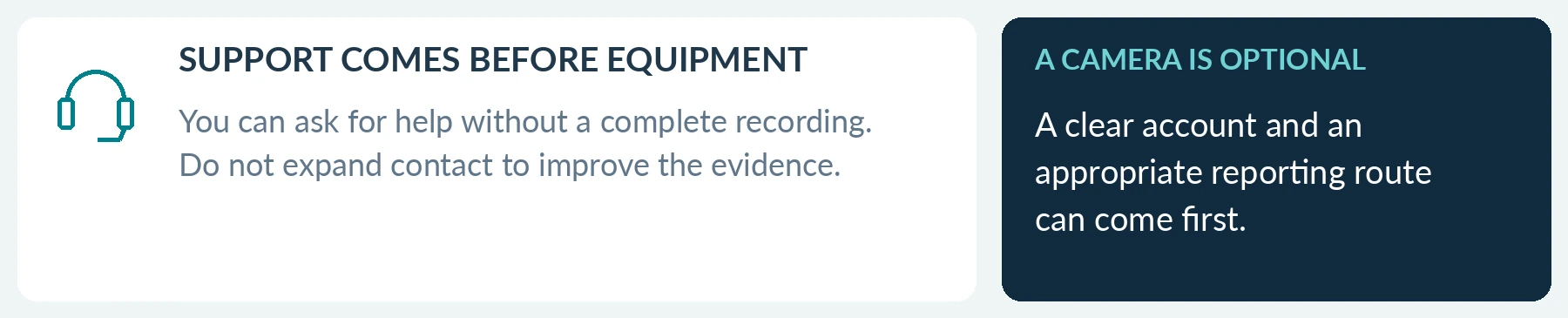
For US readers, SPARC provides information, logs, and routes to local victim-service assistance, but it is not a direct crisis-response service. Use its resources to find appropriate help rather than sending it evidence expecting an investigation. [4]
In the UK, the Suzy Lamplugh Trust's National Stalking Helpline is 0808 802 0300. Its official page provides current contact options and service information. It is not a replacement for emergency services. [19]
Elsewhere, ask a local victim-support organization or legal-aid provider for the relevant reporting, safety-planning, and recording advice. Your choice about documentation should fit that plan; buying more equipment is not automatically the next step.
The Bottom Line
A body camera can be one part of an appropriate incident record. It should never become a reason to create contact, remain in danger, or feel that you must prove everything before asking for help.
Record observations accurately, identify gaps, preserve relevant originals, protect access, and use the appropriate private reporting channel. Consider a camera only when it addresses a lawful, practical recording need that simpler methods cannot meet.
For a SpikeCam equipment question, describe only the technical requirement and country or region—not another person's identity, your safe address, or private incident footage. Request confirmation for the exact model; this guide does not certify pre-recording, encryption, remote monitoring, emergency assistance, or evidentiary acceptance for any unverified product.
The goal is a clearer record and appropriate support—not more confrontation or more footage at any cost.
Sources checked September 26, 2026. This article provides general information, not case-specific legal advice, a safety guarantee, or an assessment of any person's conduct. UK, EU, California, and other resources retain their stated scope; the cited ICO guidance is marked as under review. Manufacturer examples are documentation references, not rankings or hands-on results. Templates and exercises are fictional editorial tools, not official forms, certified forensic procedures, or promises of legal acceptance. No unverified capability is attributed to SpikeCam.
WORKSHEET A / OPTIONAL PERSONAL RECORD
Incident record
Complete only when safe. This is an editable aid, not an official form, a requirement to report, or a determination of misconduct.
Keep safe addresses, relocation plans, passwords, and unrelated private details out of this worksheet. Ask an adviser how necessary sensitive information should be handled. [11]
| Reference and timing | Your entry |
|---|---|
| Incident reference | |
| Event date / approximate time / time zone | |
| When this note was made or amended | |
| Relevant location reference |
| What to document | Your entry |
|---|---|
| What I directly observed Separate facts from conclusions. | |
| Words and identification Mark paraphrases and uncertainty. | |
| Information from others / inference Identify the source and what is not known. | |
| Impact and my response | |
| Supporting files and limitations File references, gaps, time errors, sound or view issues. | |
| Report reference and agreed follow-up |
Optional worksheet adapted from the article’s editorial structure. Preserve original records and keep dated additions distinct. See the incident-record discussion and source scope. [2,11]
WORKSHEET B / COPIES & HANDOVER
File preservation and submission record
Use approved transfer methods and verified recipients. This worksheet is not a certified forensic chain-of-custody form. Do not delay an urgent report to complete it.
| Source and copies | Record details without passwords or unsafe location information |
|---|---|
| Incident / practice reference | |
| Source device / original filename(s) | |
| Recorded clock / known discrepancy How and when it was checked. | |
| Export date and supported method | |
| Protected source copy / backup reference Use a safe index, not sensitive account credentials. | |
| Playback verified by / when | |
| Working-copy changes Any excerpt, conversion, annotation, or redaction. |
| Submission and review | Your entry |
|---|---|
| Verified recipient / accepted method | |
| Files submitted / date / receipt reference | |
| Known limitations communicated | |
| Retention or preservation advice / next review |
Keep originals and necessary accompanying information; label permitted altered copies separately. Receipt does not establish that every file has been reviewed. Editorial tool based on the article, not a legal or forensic certification. [12–13]
SOURCES / REFERENCE NOTES
References and source scope
Source-check date recorded in the supplied manuscript: September 26, 2026. Source titles below are clickable. Each source retains its stated scope.
[1] Police.uk — How to report stalking or harassment
Reporting without first gathering evidence; urgent help. UK policing guidance, not a universal reporting procedure.
[2] Police.uk — What to do now if you're being stalked or harassed
Minimizing contact and making notes of relevant incidents, timing, and witnesses.
[3] NNEDV Safety Net — Documentation Tips for Survivors of Technology Abuse & Stalking
Documentation safety, possible escalation when documentation is discovered, and app-specific screenshot or screen-recording notifications.
[4] SPARC — What To Do If You Are Being Stalked
US resources and routes to local victim-service providers; SPARC does not itself provide direct victim services.
[5] GOV.UK — Resolving neighbour disputes: Overview
Distinguishes ordinary dispute routes from reporting violence or harassment; jurisdiction-specific guidance.
[6] Police Scotland — Stalking and harassment
Advice on avoiding engagement and meetings in a stalking situation; not a mediation rule for all neighbor disagreements.
[7] Metropolitan Police — Report stalking or harassment
Reporting where the legal label is uncertain or evidence is absent; a single incident may be another type of offense.
[8] California Legislative Information — Penal Code section 632
Confidential communications, consent, and statutory qualifications. California example only, not case-specific advice.
[9] ICO — What does this guidance address?
Scope of organizational surveillance guidance and purely personal/household exclusion; marked as under review when checked.
Section 2.3: narrow interpretation of the household exemption and public online disclosure; national requirements remain relevant.
SOURCES / REFERENCE NOTES CONTINUED
References and source scope — continued
[11] SPARC — Stalking Incident and Behavior Log
Documentation fields and warnings about safe storage and potential later disclosure. The article worksheet is independently written, not a reproduction of the official form.
[12] NIST — Digital Evidence Preservation: Considerations for Evidence Handlers, NIST IR 8387 (2022)
Professional preservation guidance on sources, copies, security, and integrity checks. Not certification of a reader’s process.
[13] SWGDE — Video and Audio Redaction Guidelines, 18-M-001, version 2.3
Working copies, documentation of redaction, clearly identified outputs, and verification. No endorsement of SpikeCam or an individual workflow is implied.
[14] NNEDV Safety Net — Technology Safety Plan
Safer devices and planning changes to accounts or access in the context of possible abuse and escalation.
[15] Apple — Set up and use iCloud Photos
Synchronized deletion and the distinction between iCloud Photos and iCloud device backup. Applies to files actually managed through that service.
[16] Axis — Body worn solution user manual
Model- and configuration-dependent prebuffering, buffer audio, and postbuffering. Not a specification for every camera or SpikeCam.
[17] Axis — Troubleshooting guide for image quality
Moving-subject blur and shutter-speed trade-offs; not a hands-on result for the products discussed.
[18] Axis — AXIS W110 Body Worn Camera user manual
Separate battery and storage operating limits and effects of settings and conditions; product-specific example.
[19] Suzy Lamplugh Trust — National Stalking Helpline
UK helpline number and current contact information. Check the service’s opening and contact details; not an emergency service.
About this illustrated edition: the full reader-facing article and its source notes are retained. Added diagrams and worksheets are editorial aids, not real incident evidence, measured product performance, official forms, or an assessment of any person.
Related articles
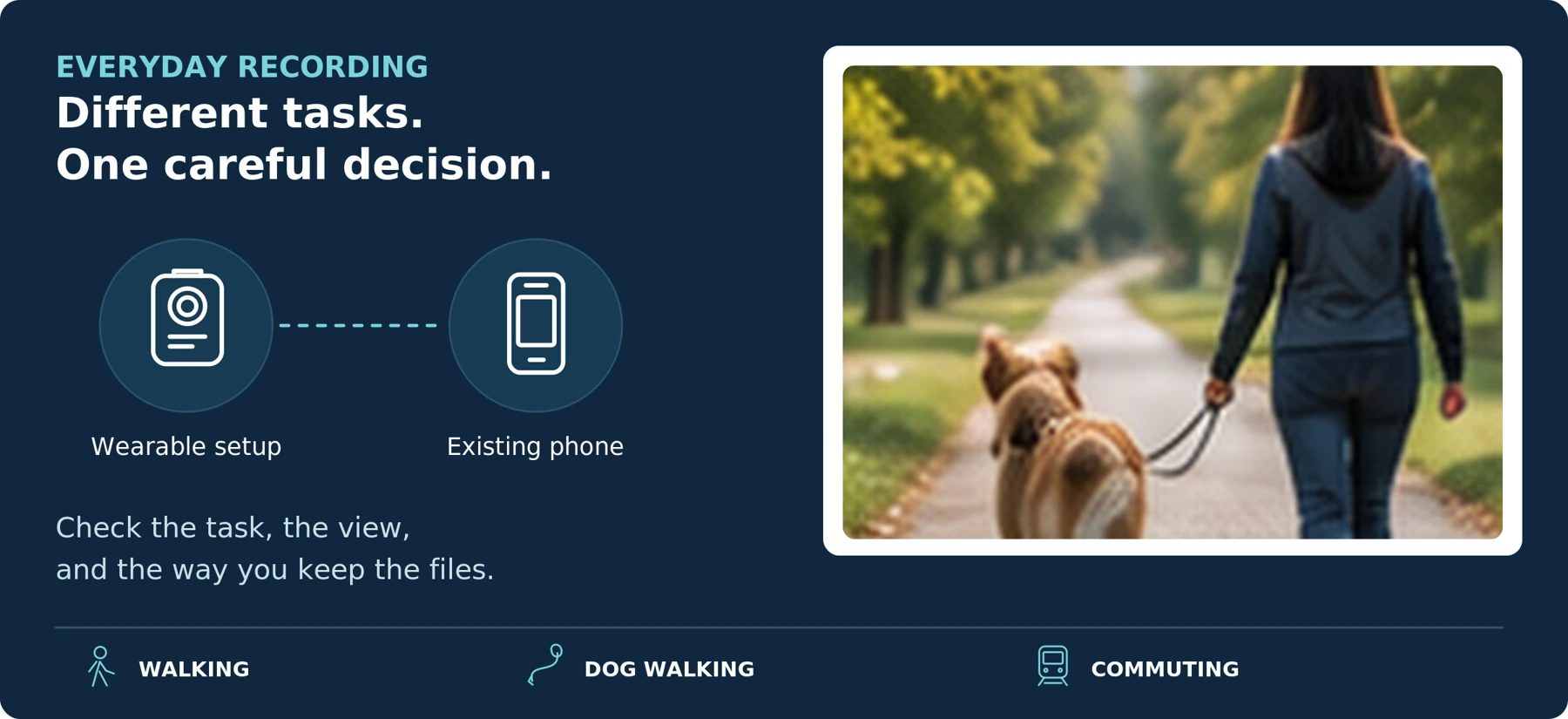
Body Cameras for Personal Safety: Walking, Dog Walking, and Commuting
Understand the limits of recording and keep safety, getting help and privacy ahead of equipment.

Body Cameras for Cycling: Chest vs. Helmet Mounting
Compare actual riding views, mount security and recording needs before choosing a camera position.
Body Camera Buying Guide: How to Choose the Right One
Choose a camera around recording controls, battery life, file access and your actual working routine.